
RIG Riot Garage and Customization
Outer and inner parts, set shells, saved palettes, loadouts, and capacity math.
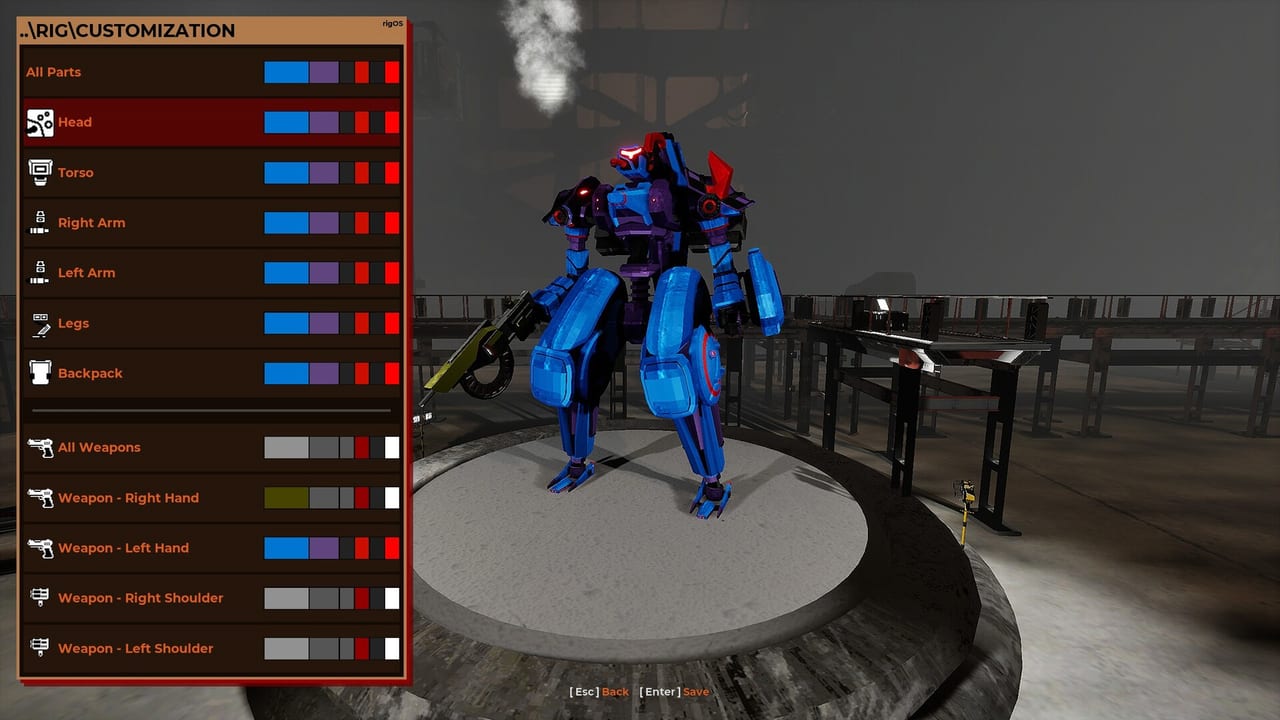
This page is for pilots who survive raids and then stare at the garage like it is a second game. It is. RIG Riot’s permanent progress is not a talent tree. It is a pile of shells, inner systems, colors, and loadouts you assemble between drops. If you do not know how parts drop, skim how to get parts first, then come back to equip them without wrecking your weight budget.
The garage is where you equip parts, save colors and palettes, customize weapons, and pick Armory starters for the next raid. Weapons found during a run can be saved to loadouts. That matters: a gun you liked in the field can ride with a frame you built at home. New pilots who still mix up Scrap and tokens should keep getting started nearby so they do not recycle a rare arm for a handful of Armory points.
Outer parts, inner parts, and set shells
Outer parts are head, torso, arms, legs, and backpack. They drop from defeated enemy RIGs. Inner parts are boosters, target acquisition systems, and generators. They drop from non-RIG enemies. You are not collecting finished catalog items. You are collecting components from sets and assembling them.
An arm is a useful example: shoulder shell (recoil plus melee), upper arm (recoil), forearm (melee). Mix a Scout shoulder with a Bulwark forearm and you get a hybrid the UI will not name in one adjective. Sets in the interface include Scout, Scrapper, Bulwark, Assassin, and Watcher pack. Rare part mods add percentage bonuses after the Quad Leg update.
Legs are a fork. Quad Legs are ground-focused and can drop with any new leg part. Biped legs also drop as of July 2026. Do not glue Quad Legs onto a Watcher pack you built for horizontal speed. That same update doubled Watcher pack horizontal speed and raised Assassin load limit. Fortified now gives equal Weight and Weight Load instead of flat capacity, because four heavies on every frame was too free. Inner parts were fully reworked — sort alphabetically and compare stats from the parts menu.
Watch this next: how customization was designed
Sage’s customization devlog is the reason this garage exists: thousands of parts from mixed set components, not a handful of named frames. Watch it for the design intent, then come back and save a loadout before you experiment. Unsaved personalization can be lost; the garage asks if you are sure when you leave without saving.
Loadouts, palettes, weapons, and Armory starters
Weapons save to loadouts. Colors and palettes can be saved. Interface customization and a HUD opacity slider exist because Raid Status text is dense. Official channels for screenshots and bug reports sit on the links page.
You can equip multiple starting weapons. That is powerful and dangerous. Fewer predetermined guns keep the upgrade pool interesting. A Void Slot starter (Blocked Slot after a rename) prevents a slot from being considered while options generate. Leave a slot blocked if you do not want the Armory painting you into four heavies.
Weapon customization is separate from Volatile Mods. Augments change that weapon only. Shortlist run mods on the Volatile Mods tier list, then test them on a loadout you can fly. Gun rankings belong with the weapons and Volatile Mods guide. Scrap is for the Armory and recycling — a demo patch refunds 50% when recycling upgraded parts. Do not recycle your only Assassin arm because the Armory wants a level. Settlement rerolls are the spend that pays you back inside raids. Save before you leave; the garage asks if you are sure.
Weight, capacity, and a build you can actually raid with
Weight versus weapon capacity is the garage’s real puzzle. Weapon damage is balanced against weight requirement, so extra capacity is extra damage budget. Build that on purpose with Assassin load limit, inner systems, and part mods — not with random rares that all say more guns.
A practical first goal: one movement frame (Scout or Watcher pack, Quad or Biped) and one carry frame (Assassin or Bulwark) with room for a medium plus a light. Scrapper is the loot-forward set; its backpack repair pickups have a world icon. Wear both frames in a raid before you trust the builds tier list. A list cannot feel Quad Legs for you.
Next steps after you save a loadout
Save a palette you can recognize in a screenshot, save a loadout with one blocked slot, and run a Mission raid without touching the garage mid-panic. Then farm missing shells with how to get parts. When the frame is stable, spend the next hour on weapons and Volatile Mods so the guns you carry actually match the weight you just accepted.
Frequently Asked Questions
Quick answers to the most common RIG Riot questions.
What is the difference between outer and inner parts?
Outer parts are head, torso, arms, legs, and backpack from enemy RIGs. Inner parts are boosters, target acquisition, and generators from non-RIG enemies. Drop details are on how to get parts.
Can I save colors and weapons between raids?
Yes. Colors and palettes can be saved, and weapons save to loadouts. Confirm you actually saved before leaving — the garage prompts you. Official channels are listed on the links page.
Should I equip four starter weapons from the garage?
Usually no. Multiple starters exist, but fewer predetermined guns keep the upgrade pool interesting. Void Slot / Blocked Slot is there to keep a slot out of generation. Starter logic is also in getting started.
Quad Legs or Biped legs?
Quad Legs are ground-focused. Biped legs keep the flight-leaning profile. Both can drop. Try each on the same torso before you trust a builds tier list label.
Where do Volatile Mods fit if the garage is for parts?
Volatile Mods are in-run, six slots, no stacking. The garage stores parts, palettes, and weapon loadouts. Pick candidates from the Volatile Mods tier list then find them in chests.